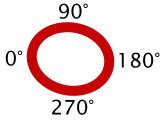
 Here's
a cross-section through a graphite shaft. The shaft is not perfectly
round; it is a little bit elliptical. (No shaft I've ever seen is this
bad, but the drawing exaggerates, to make the point more intuitive.)
Obviously, the shaft is not going to be the same stiffness in all
directions. The wider the shaft is, the more it can resist bending.
So...
Here's
a cross-section through a graphite shaft. The shaft is not perfectly
round; it is a little bit elliptical. (No shaft I've ever seen is this
bad, but the drawing exaggerates, to make the point more intuitive.)
Obviously, the shaft is not going to be the same stiffness in all
directions. The wider the shaft is, the more it can resist bending.
So...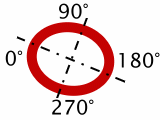 The
lines show the widest and the narrowest axes of the ellipse. These
correspond to the stiffest and the "weakest" (most flexible) directions
of the shaft. A few points to note:
The
lines show the widest and the narrowest axes of the ellipse. These
correspond to the stiffest and the "weakest" (most flexible) directions
of the shaft. A few points to note:- We've labeled the directions around the shaft by degrees, so we can talk about a direction. For instance, the long axis runs from about 25º to 205º.
- The two axes are at right angles to each other -- 90º apart.
So far, this is pretty sensible and intuitive. The next step is where it gets counter-intuitive to people without engineering training.
Using the example of an ellipse above, it is easy to see that the spine is symmetrical (the spine directions are 180º apart), and the most flexible directions are also 180º apart -- and 90º from the spine. But what about a figure that is not so symmetrical?
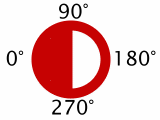 Here is a cross-section that is about as lopsided as you could imagine. What is the "hard" and "soft" side of this shaft?
An intuitive guess would say that the stiffest side is at 0º, and the most flexible at 180º. But that is not correct. There are stiff sides at 0º and 180º, and flexible sides at 90º and 270º.
In fact, that's a general rule. Leaving aside the reasoning (it's in textbooks, and I don't want to go off on a tangent here):
- The spine is a plane, showing up as "sides" 180º apart.
- The most flexible direction is also a plane, also showing up as "sides" 180º apart.
- The stiffest and most flexible planes are 90º apart from one another.
Always! The cross-section of the shaft does not matter.