
|
 |
Home ⇒ misc ⇒ other ⇒ Current Article |  |
Article
Contents
Coaching kids' soccerPosition PlayDave Tutelman --
September
9, 2018
Teaching soccer skills is the obvious part of the coach's job. But teaching game flow and position play is probably more important. Not only will it determine how well the team plays (which if you recall is not my first criterion for my own success), the kids are learning the essence of the game. They will not enjoy nor stick with a game that just swirls around them with their not understanding what is happening. And learning the game flow will let them appreciate the game as a spectator, even if they decide they don't want to play it. Last but not least, position play is safer. Have you watched younger kids playing soccer? They play "swarm". Any question of why they need shin guards is put to rest when you watch just a minute or two of that game. On the other hand, if the kids are each playing their own position, you have only two or at most three players challenging one another for the ball at any moment. Very different from the swarm, where every kid except the two goalkeepers is flailing away in the vain hope they might catch a piece of the ball. Early in the season, I would send home a handout on position play, with this cover letter. It enlists the parents' help in reviewing a few simple principles of play for each position. (I tried to limit myself to three principles per position, and for the most part I succeeded.) If the kids can learn and apply these principles for just two of the positions, they will be much better players. A kid under 10 with this sort of position discipline is a dream to coach. Here are the position prinicples I attached to that cover letter. I have two sets, the handwritten one for seven and under, and the typed one for eight and nine. They are very similar -- hey, the principles don't change -- but the one for the older kids may have more rules and a more complete explanation. Another thing I put in the older kids' principles is "what is your job?". I identified the first objective for each position. In most cases it is obvious (e.g., the goalkeeper's job is to keep the ball out of the goal), but in other cases it may be surprising. And in the surprising cases, it took a few years of coaching before I "got it". So here are the rules of position play for each position, followed by two bonus sections: drills for teaching and reinforcing some position play principles that kids violate all the time, and things to look for when matching kids to positions. But first, a note about formations, the systems of positions. FormationsElite soccer teams typically play a 4-4-2 formation, that is 4 defenders, 4 midfielders, and 2 forwards. Occasionally you will see a 4-3-3, but seldom anything more offensively weighted than this. There are several reasons professional and national teams are this heavily defensive:
 None of this is true in recreational soccer, especially the younger ages. In fact, the most common formation in rec soccer when I was coaching was the 3-3-4, a heavily offense-weighted system. With 20:20 hindsight, I can point to a single skill factor that really dictated the formation. Below
age 10, the skill
shown in kicking a ball -- both power and accuracy -- falls off
tremendously as soon as you are no longer kicking a ball back in the direction it is coming from.
Think about the flow of a soccer game. Simple defense almost always calls for the easy kick -- send it back the way it came. On the other hand, scoring usually requires at least a 90° turn of the ball, and often an obtuse angle up to 180°. That gives the defense a much larger advantage than in the professional game, due simply to the skill set required between defense and offense. The obvious answer is to load up the offense at the expense of the defense. And the result is scores not that different from professional scores. Maybe a little higher, but not silly high. If the professionals played a 3-3-4, you would see "run-it-up" scores. If you're thinking ahead, it just occurred to you, "If I can teach my kids how to turn the ball with accuracy and power, we'll win everything." And indeed you would. Just be sure you don't get ahead of yourself. The most important skill to teach kids about kicking is don't reach for the ball; be sure you're over it when you kick it. Reaching results in missed kicks usually, and weak, misdirected kicks otherwise. And when you have to turn the ball, the chances of having to reach for it multiply; it's much harder to get over the ball for a right angle or more. If you emphasize angled kicks too early -- before they are decent at kicking stationary balls and balls coming from the direction they are kicking -- the kids will not be kicking the ball at all. GoalkeeperHere are the handouts for the younger and the older kids.As I said above, the goalkeeper's job is obvious. Keep the ball out of the goal. The principles of position play for the goalie are:
DefendersHere are the handouts for the younger and the older kids.The defenders' job was a surprise to me, once I finally figured it out; it took a couple of seasons. It isn't to prevent shots on goal. On the contrary, it is to force poor shots on goal, weak or poorly aimed. Shots that any competent goalie can handle. It took me a few seasons to learn, but once I realized it I was ashamed it took me so long. It's the same reasoning as the assertiveness requirement for goalkeeper; if you back up as a defender, you are making it easier for the other team to score. To make it harder for them to score, you must meet the attack and force it. Indulge me while I recount the anecdote that clinched this one for me. Yes, I knew it before this, but now I had a definitive story to back it up. My kids that year were the 8- and 9-year-olds. D was playing goalkeeper; he was big and athletic, and enjoyed the spotlight of the 'keeper spot. In the first half, the opposing center forward got by our defenders three times for point-blank shots; no way D could have stopped them, and he didn't. During the half-time break, we talked about what was happening. Our center defender was showing their center forward too much respect, not crowding him and forcing a shot but rather backing off and giving him real estate closer to the goal. D was the one who saw that the most clearly, watching from just in front of the goal. So we moved D to center defender, the center defender to left defender, and the left defender to goal. G, the new goalie, was tall and gangly. Not tremendously coordinated nor quick because he was still growing into his height, but he had reach and had strength enough to kick a big punt. Both these skills were important for a goalkeeper. The idea was that D would take on their center defender and force weak shots from further away. The other team was completely shut down in the second half. G made a lot of saves, but they were all easy saves. And his long punts gave our offense a lot of good opportunities. The moral here: if you have assertive defenders, you don't need a quick, athletic 'keeper. You just need basic goalie competence, and can select a guy with a strong clearing kick and punt. So the first objective for the defenders is to press the opposing forwards, so they take shots before they are really ready to. At this age, you don't need to steal the ball, just force them to kick it so the goalie can handle it easily. The second objective is to clear the ball safely. That means that if you can't give it a good ride downfield, then clear it to the side. You even see the pros doing this. The most obvious defensive mistake is for your clearing kick to result in an easy play on goal for the other team. MidfieldersHere are the handouts for the younger and the older kids.The midfielders' job is to control the middle of the field, to smother the other team's attack before it can reach your defense, and to feed your offense to a scorable situation. Midfielders know they're doing a good job if your defenders are bored. The position and game flow keys for the midfielders to make that happen include:
In this same vein, let me generalize what I said in the previous paragraph. Every common situation should have a plan, every kid should know that plan, and it should have been drilled, at least in scrimmage. The plan for my under-ten teams included:
ForwardsHere are the handouts for the younger kids. Once the kids are older and have a little more position discipline, the position objectives and rules are different for wing forwards and center forwards, so they have separate pages.Yes, there are differences between position play for wings and strikers, but there is a common, important rule for their movement: Stay ahead of the advancing ball and be in a place where you are an easy, attractive passing target. That means "finding space", a position skill to work on with all field positions. As for the differences between wings and strikers:
That is as much as you are likely to get across to a seven-year-old. But as the kids get older, and especially over ten, there are a few other points to wing play that they need to master. And these don't require talent, just awareness:
Practice drillsThe younger kids play swarm. If you have ever watched them, you know it. It's almost an impossible habit to break. There are other bad habits that younger kids -- and the occasional older kid -- will exhibit. Holding the ball too long because you don't trust yourself to kick it before "teeing it up" perfectly. Holding the ball too long because you don't trust your teammates; you're convinced you're the only one of the team who can get it done, so you don't pass. Etc etc etc.It is hard to break these habits with static drills, "static" meaning contrived situations during the first half of practice. Kids may execute them OK, but not be able or willing to call on that experience in a game. But we can carry over the drills to our nearest thing to a game -- the scrimmage. If members of my team had bad habits, I would invent an extra rule or two that excessively penalizes the behavior. Then we would play our scrimmage game with the extra rule in effect. Here are some examples:
You get the idea now. If you have a game-situation or game-flow problem, invent a rule to penalize the bad behavior and impose it in your team scrimmage. It really works! How do I know it works? The second time I coached the sevens, I was using these modified-rule scrimmages. By the end of the season, my teams had the best position play and the best teamwork in the league. As a result, we won all our games in the last half of the season. I didn't set out to win games, but if you can teach seven-year-olds just a little position discipline -- it doesn't have to be a lot, just don't swarm -- they perform head and shoulders above a swarming team. Matching players to positionsThere is considerable "conventional wisdom" about the physical characteristics for a given position. Listening to discussions on this, you would almost think you could look at a player and know where to place him in the lineup. My experience says that the conventional wisdom is a start, but far from a finish. My own considerations for the positions require watching them play, sometimes for several scrimmages and even games.Fortunately, that is right in line with my philosophy. Before age 10, I want to give every kid a chance at every type of position: forward, midfielder, defender, and -- only if they want it -- goalkeeper. So with those ages, I get to see them for several games before I even try to find them a "permanent" position for the season. BTW, that is part of how I came up with the considerations below. If I tried to typecast them at the beginning of the season, I'd never have known what they could do; they'd be stuck based on physique and the "combine" skills. Defenders - Conventional wisdom says they should be big and strong. That's OK as far as it goes, but here are some considerations that are more important, so much so that they override the conventional wisdom every time they apply:
It is easy and tempting to put your weakest players at the outside midfield spots. I have to admit I often did. They do the least damage there. Well, the damage may be done but:
Don't be afraid to do extra coaching of the weak midfielders, or even playing with the formation to strengthen the midfield. Here are a couple of anecdotes in support of my position:
Goalkeeper - Conventional wisom says the goalie should be tall and one of the best athletes on the team. For rec soccer, and especially pre-teen, I do not concur with the latter. If the defenders are doing their job, the goalie doesn't have to be quick and athletic. I have already cited an anecdote supporting this position. Tall is good. More reach, especially vertical reach. At the younger ages, there is a gap of more than a ball diameter between the crossbar and even the tallest goalie, so the taller the better. The ability to kick and punt the ball a long way is a big advantage at this age. Younger than age 10, clearances and goal kicks rarely make it out of the penalty area on the fly. If your goalie can make such kicks, that can be huge. Not only effective, but intimidating against an offense that is used to easy pickings by bottling up the ball in the other team's end. I always ask in the first or second practice of the year, "Who is interested in being a goalkeeper?" Sometimes as much as half the team raises their hands. The first goalie practice usually gets rid of half of them. Keeping goal in a scrimmage gets rid of more. They originally thought they'd like the attention, but with the attention comes responsibility and pressure. (You can say anything to try to take the pressure off them. It won't. They know.) But a few really like it. If you're lucky enough to have three goalies on your roster, don't try to trim it down. You may have a favorite 'keeper, but include the others at least one quarter of the game. You never know when number one can't get to a game or is injured during a game. So keep the others in touch with their goalkeeping abilities even as you use them mostly as field players. Other considerations
I mean, this is counter to what soccer coaching books say and what coaches say on TV. "Hey Dave, what do you know? You've only coached recreational soccer." Exactly! I said up front I'm talking about rec soccer, not elite soccer (whether traveling team elite or national team elite). The elite players are all way above rec players in skill, speed, and conditioning. In fact, they are more alike than different in these areas. They are certainly more alike than are rec soccer players. At the elite level, you don't have to worry much about quickness, nor endurance, nor ability to turn on the ball. They're all pretty darn good at that, and only a few really stand out in that regard. So you look at other characteristics -- and those characteristics become the conventional wisdom. In recreational soccer, there are wild differences in skill, speed, and conditioning. If there are huge differences in things like running speed and endurance, figuring out how to use those differences becomes more important than the conventional considerations like height or strength. Here's an anecdote in support of my position: I was asked to be interim coach for a 12-14-year-old team while their coach was on vacation for a couple of weeks. The team had not been doing well in its games, and the players were starting to lose interest; they were goofing off from the start of our first practice. (Though that's not unusual for junior high school kids anyway.) When we got to scrimmage, I asked them to play their usual positions. I could see immediately that (a) they had been positioned by the conventional wisdom and (b) it just didn't work. During the scrimmage, I moved them around based on what I saw, according to the principles I just cited. By the time I was done, half of them were in different positions from their usual. The first game in their new positions was against a strong team; we were expected to lose badly. We lost, but it was a good game; the final score was something like 3-2. The other game I coached, we were unexpected winners. The kids felt more comfortable in the new positions and played better as a team. They also seemed more into the soccer than when I met them at our first practice. So it does work. Last modified - September 15, 2018
|
 This
time it was 10-11-year-old boys, and I had coached them or
watched
them on other teams for several years. I was well aware of what each
was good and not-so-good at. We were losing a game, and it was obvious
even to them that the problem was our lack of control of the midfield.
We had a war council at halftime. I let them talk, but I asked a lot of
leading questions. We needed to beef up midfield, maybe even add a
midfielder -- a 3-4-3 formation. Good idea; let's do it! How would we
organize it, because we hadn't practiced it? We had M, who was very
offense-minded, and K, whose tendencies were defensive. (Based on his
talents, I had started him at center forward early in the season, but
he kept dropping back when we didn't have the ball until he was helping
the defenders. After that, he was my center defender.) We decided that,
rather than string the midfielders across the field, we'd place them in
a diamond. M's job would be to cut off clearances by the other team's
defense, and K's job would be to stuff their offense before it reached
our defense. It worked beautifully, and we dominated the second half
and won the game.
This
time it was 10-11-year-old boys, and I had coached them or
watched
them on other teams for several years. I was well aware of what each
was good and not-so-good at. We were losing a game, and it was obvious
even to them that the problem was our lack of control of the midfield.
We had a war council at halftime. I let them talk, but I asked a lot of
leading questions. We needed to beef up midfield, maybe even add a
midfielder -- a 3-4-3 formation. Good idea; let's do it! How would we
organize it, because we hadn't practiced it? We had M, who was very
offense-minded, and K, whose tendencies were defensive. (Based on his
talents, I had started him at center forward early in the season, but
he kept dropping back when we didn't have the ball until he was helping
the defenders. After that, he was my center defender.) We decided that,
rather than string the midfielders across the field, we'd place them in
a diamond. M's job would be to cut off clearances by the other team's
defense, and K's job would be to stuff their offense before it reached
our defense. It worked beautifully, and we dominated the second half
and won the game.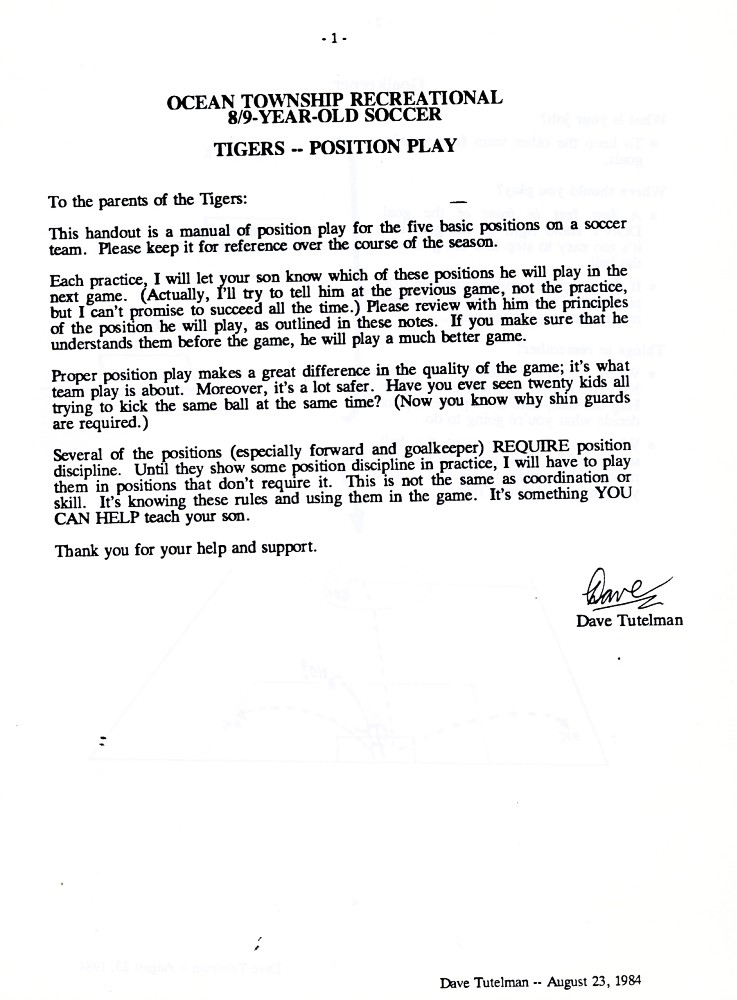


|
|
|