Begin by cutting the hardwood plywood back piece to its suggested
rectangular size.
Also cut the rectangular, vertical support
pieces out of hardwood or hardwood plywood, If you use hardwood, the
grain should run lengthwise. |
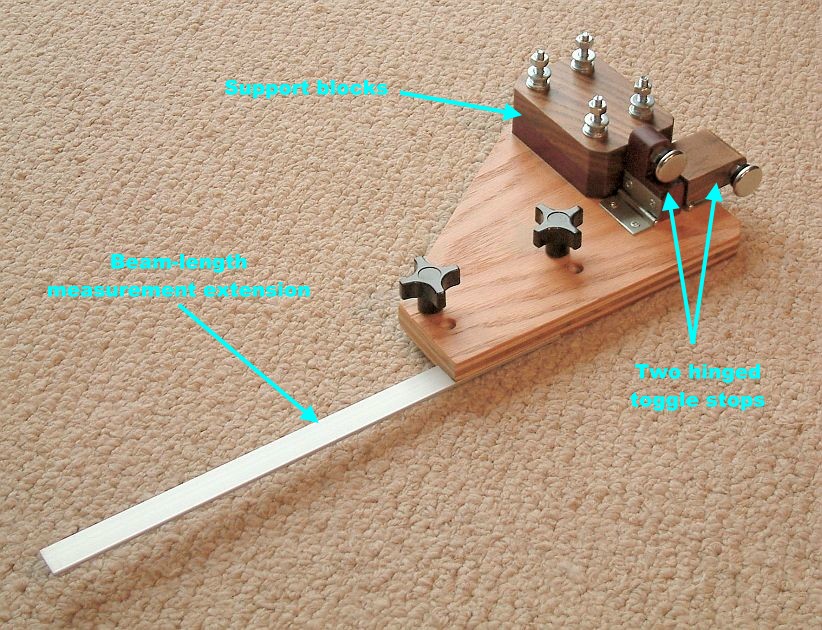
Cut the slot in the back, lower left of the main toggle board
piece, the slot for the aluminum beam-length measuring extension. This slot can be cut with a table saw and the piece held
vertically, or with a router. It is ok if the cut runs a little
longer or wider than the plans call for, as it would be in the event of
using a table saw.
|
 On the front of the main toggle board, very carefully measure and mark the
location of:
On the front of the main toggle board, very carefully measure and mark the
location of:
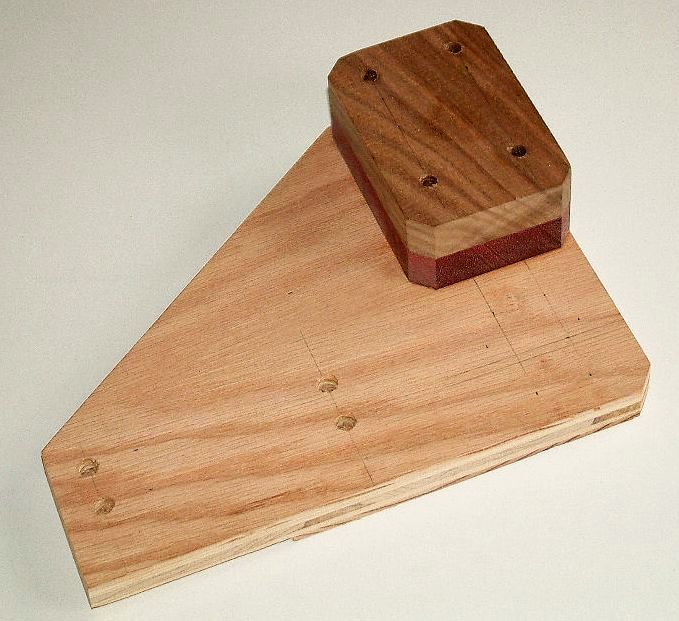
- The four 3/8”holes.
- One of the 1/4" holes, the lower left one, as viewed from the front of the board.
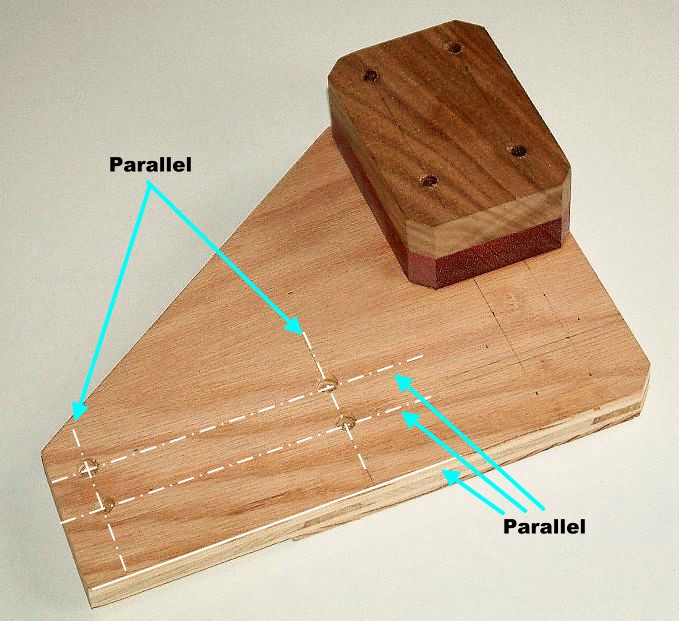
The position of the 3/8" holes is very critical to proper operation. In particular:
- The lower pair of holes must share a centerline that is exactly parallel to the lower edge of the board.
- Slightly less critical, but the same is true of the upper pair of holes.
- The centerlines shared by the right and the left pair of holes must be parallel.
These three criteria are shown in the photo.
|
Create starter
holes for drilling at each of these marks.
Next, clamp the toggle board down to your drill press table so that you
drill is as accurately aligned as possible and the holes are drilled
perpendicular to the surface. Use a very small bit, maybe
1/16” or 3/32”; it should be smaller than the pilot point of the bits
you will use to drill and to counterbore the holes. Drill completely
through the piece, from the front,
at each location.
|
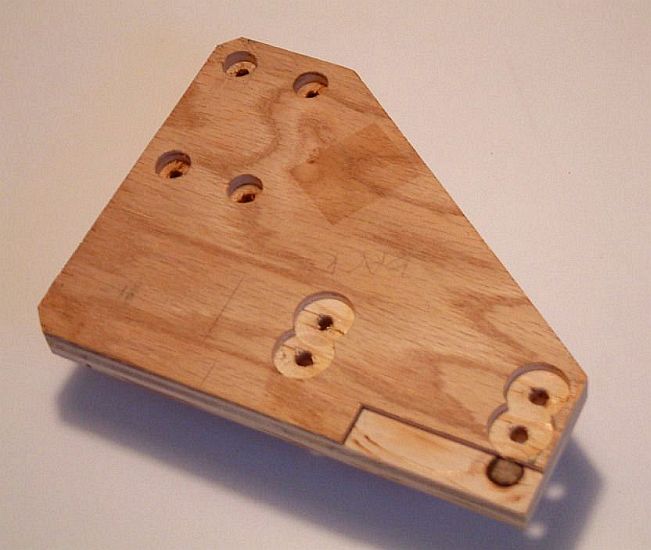
On the back of the toggle board, there should now be 5 small holes
showing. On the four holes that will eventually be drilled to 3/8", proceed to drill the counterbores to the size and depth
indicated in the plans at each location, using the small pilot holes as
a guide to position the bit.
From the front of the board, use the same small pilot holes to the
drilling of the full size holes. Drill all five, but note that one of them must be only 1/4".
Note that the plans ask you to
drill the 3/8" holes
to a starting diameter of 3/8”, but that they may need to be adjusted
to fit the outside diameter of your t-nuts. They should end up in
the range of 3/8”, 25/64” or 13/32”, based on what the beta builders
experienced. You want a fairly snug fit, not a loose and sloppy
fit.
The 3/8" holes also have a small
countersink inside the counterbore at the back edge of the hole.
Those should be drilled next.
|
With the holes drilled and notches cut, you should cut the angle on the
back piece of the toggle board. First draw the location of the
angle on the front of the piece. On my table saw, it turned out
that the cut angle was just under 36º on the miter guide
(35.8º, calculated in the plans). You might make your first
cut can cut away from the line a little bit to visually confirm that
your angle setting is correct before you make the final cut.
Now would be a good time to round or chamfer the edges of the support pieces, if you plan to do so. |



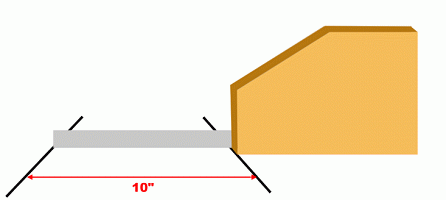 Find
a perfectly flat tabletop. On it (or on a large piece of cardboard or
hardboard on the tabletop) rule two parallel lines exactly 10" apart.
Find
a perfectly flat tabletop. On it (or on a large piece of cardboard or
hardboard on the tabletop) rule two parallel lines exactly 10" apart.