 You
may want to save bench space by mounting your NF4 on the wall. The
instrument was designed with this in mind. The legs project out the
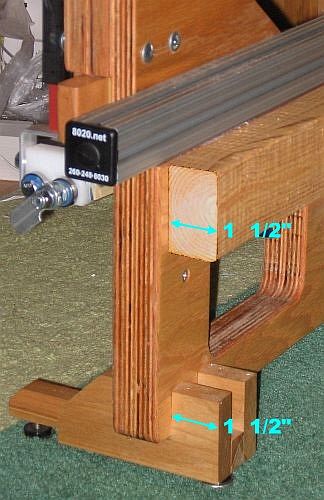
back of the unit 1½ inches. Not coincidentally, 1½ inches is also the thickness of a piece of 2x3
lumber.
You
may want to save bench space by mounting your NF4 on the wall. The
instrument was designed with this in mind. The legs project out the
back of the unit 1½ inches. Not coincidentally, 1½ inches is also the thickness of a piece of 2x3
lumber.The photo shows a piece of 2x3 attached to the upper rear of the backer board. If that 2x3 is attached to the wall, then the rear projection of the legs will keep the unit vertical. The 1½-inch spacing keeps the NF4 far enough from the wall so that there is room for the fingers to grab the cam levers without scraping any knuckles. There is also room for the hand to go behind the toggle board (which may be necessary in a future toggle board design).
Of course, you should not mount it permanently on the wall. You may want to remove it for maintenance or a field trip. (Remember, your NF4 is completely portable.) The diagram below shows how to build a mount which holds the NF4 solidly without attaching it to the wall permanently.
Note: What follows are not step-by-step instructions. Read the whole thing, so you know how everything is supposed to fit together before you cut or attach anything.
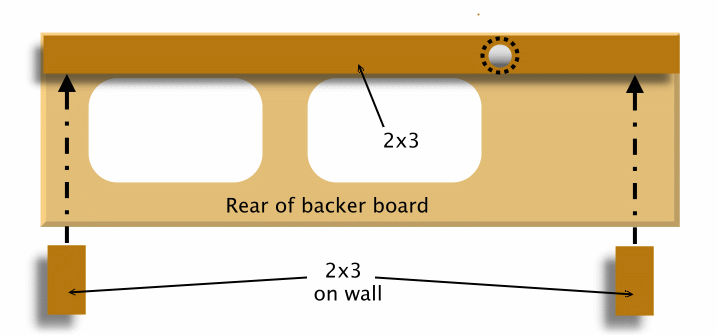
Attach a piece of 2x3 the length of the backer
board horizontally to the upper rear of the backer
board. You will have to rout or counterbore a recess in the 2x3, to
accommodate the rotator board pivot bolt's head. Screw, but do not
glue, the 2x3 to the backer board. (You may have to remove it, on rare
occasions, for maintenance that requires removing the pivot bolt.)
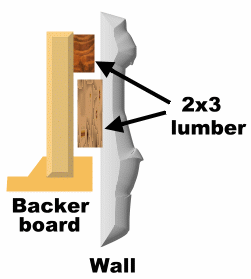 Attach
two short lengths of 2x3 vertically to the wall -- that is, with the grain vertical. The 2x3 on the backer
board will rest on the 2x3 blocks on the wall. Here's an end view of
what it looks like. Also, a few considerations:
Attach
two short lengths of 2x3 vertically to the wall -- that is, with the grain vertical. The 2x3 on the backer
board will rest on the 2x3 blocks on the wall. Here's an end view of
what it looks like. Also, a few considerations:(1) Locating the NF4 properly on the wall should be your primary consideration. Pay special attention to the placement of the wall-mounted blocks. Some things to watch for:(2) The wall-mounted 2x3 blocks should not be more than 4" tall. Otherwise, they might interfere with the legs of the NF4. (Remember, there is only 4" between the top of the leg and the bottom of the 2x3 mounted on the backer board.)
- The blocks should be at least as far apart as the legs, to assure an equally solid base as table-top use.
- The blocks should not get in the way of hand access. That means they should probably not be behind the cutouts.
- If possible, place the blocks on studs behind the wall for structural support. (More about this below.)
- The NF4 should be the right height for all hand operations to be comfortable.
- The NF4 should be the right height so it is easy to read the digital scale; this involves both lighting and having a good eye angle without having to bend or stretch excessively.
- The NF4 should not interfere with other operations in the work area below it.
The meeting of the wall-mounted and backer-board 2x3 blocks cannot be a simple flat surface. There must be some "locking device" to prevent the backer-board from slipping away from the wall. Below are a couple of ideas for locking the 2x3 blocks together.
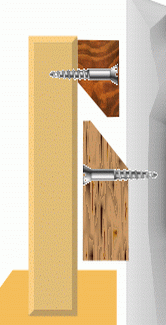 The
simplest locking device is a bevel on both blocks, as shown in the
diagram on the right. It is relatively easy to build and very easy to
mount and unmount. The NF4 simply hangs on the wall with its block hooked into the wall-mounted block.
The
simplest locking device is a bevel on both blocks, as shown in the
diagram on the right. It is relatively easy to build and very easy to
mount and unmount. The NF4 simply hangs on the wall with its block hooked into the wall-mounted block.Important: This design depends on the strength by which the blocks are secured to the wall and backer board. The diagram shows screws very close to the bevel. That's because the weight of the NF4 is pulling the blocks away from the backer board and wall, respectively, at those points. You need several screws near the edge of the bevel to keep the blocks from pulling the screws straight out of the wall and the backer board.
A direct consequence is the need for the 2x3 blocks to be mounted to wall studs or something equally secure. There is no way that attachments in drywall -- be they Molly bolts, spring-type wing bolts, or similar devices -- will provide enough strength.
Suppose you don't have studs in the right place? What are your alternatives?
(1) You can extend the backer-board-mounted 2x3 an inch or two beyond the backer board. That may well be enough. The backer board is 32" long. Many structures in the USA have studs on 16" centers, so wall-mounted blocks on 32" centers might well find studs for mounting. This calls for a slightly longer support beam attached to the backer board.
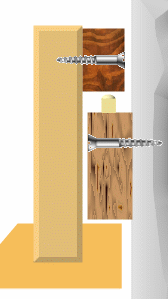
(2) If there is no way to place the mounting blocks on wall studs, you will have to find a locking device that requires less strain on the wall. For instance, you could secure dowels in the wall-mounted blocks, and drill holes to mate with them in the backer-board-mounted blocks. This will work quite nicely if you keep the following in mind:
- The wall-mounted block plus the dowel is now the dimension that must be less than 4".
- Use enough Mollies or wing bolts to support the load. At
least this time there isn't a "wedge" load pulling the bolts straight
out of the wall. But there is still the weight of the entire NF4, plus
the downward force you apply to the toggle clamp when you load the
shaft.
- Use a hefty enough dowel: 3/8" at a minimum.
- Countersink around the hole to make it easier for the dowel to find the hole when you mount the NF4 on the wall. Rounding the edges of the dowel also helps.
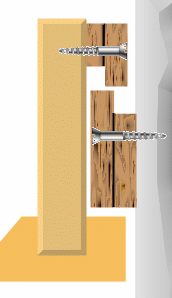
(3) Here's a variation on the wedge approach, suggested by Ed Reeder. It has flat instead of angled planes, so it doesn't try to pry the screws out of the wall. Instead of using 2x3 lumber, use leftover plywood from making the backer board and toggle board.
Two thicknesses of the plywood give the required 1½ inches. By cutting one thickness a half-inch narrower than the other, you form a lip that locks the pieces together.